
AI’s potential for asset managers
AI is the topic of the hour in insurance investment management, and for good reason. It promises faster answers, less manual work, and more confident decisions. But trustworthy AI takes more than layering a piece of software on top of the data you have today. You must get the data right first.
The opportunity with AI is real. AI can simplify complex processes like RBC, BCAR, SAA, NAIC, and rating agency, and regulatory reporting.
The challenge is that the data underneath those processes is usually fragmented across accounting books, front-office systems, custodians, external managers, and market data vendors. Producing the required deliverables is hard enough on its own. Automating them with AI is impossible until the data foundation is unified and governed.
Many organizations have underinvested in data infrastructure for years and now are trying to catch up. That takes patience for the unglamorous work of getting your data right, and that is where most firms get stuck.
Why AI doesn’t just work
When a firm realizes it has a data problem, the instinct is to point the finger at the reporting or analytics tool. The thinking is that the tool will surface insights, the insights will drive decisions, and the data problem will sort itself out in the background. It doesn’t work that way.
The tools are rarely the problem. If the data foundation is weak, a new analytical tool just puts a nice interface on top of chaos. A strong data foundation requires governance, oversight, and process controls.
I recently spoke about this at IAUM’s 5th Annual Insurance Investment Executives’ Meeting. We asked the audience how many have critical processes running in Excel right now. Almost every hand went up. Excel is not a scalable data foundation.
The firms succeeding with AI share two traits. First, leadership treats data as a strategic asset rather than an IT issue. They put clear owners in place with both business fluency and technical knowledge, and they bring in outside expertise where they need it.
Second, they invest in a data foundation built for their business that speaks their language. In this specific case, it’s critical to use a system that understands the intersection of insurance and asset management. I described the foundational pillars of data management that make AI possible.
Building an AI-ready data foundation
So what does it take to get data ready for AI? There are four layers to get it right.
- Data ingestion: This is where you land all your raw data – your accounting book, custodians, OMS, market data vendors, even your spreadsheets – and bring it into one place. Some companies stop here and add a reporting tool on top of it. This can backfire if and when the raw data sources change, causing downstream reports to break.
- Data warehouse: Think of the warehouse as organized compartments for your data, with clients, legal entities, portfolios, positions, transactions, security master, risk, and performance all organized in structured framework that ensures relational integrity.
- Semantic layer: The semantic layer sits on top of the data warehouse and presents the data the way the business thinks about it, rather than the way it is stored. It shields analysts from needing to understand the underlying complexities of upstream data processes and storage. For example, you may have a single view of positions that marries holdings with portfolio attributes, security master, analytics, ratings, and other reference data. This is also where each field is defined and aliased with synonyms so business users can ask questions in conversational language and the model will understand their question.
- Analytics layer: This can be business intelligence tools like Tableau or Power BI, or it can be AI. The key is that the semantic layer is the same, feeding into all of these different analytical capabilities consistently.
Governance
Underpinning this technical complexity sits governance: clear ownership, standardized definitions, quality controls, and alignment between the business and IT.

What it looks like to be empowered with AI and a clean data foundation
The reward for getting the data foundation right is that it’s ready for enterprise use. Rivvit’s AI-powered virtual analyst sits on top of that governed foundation and lets investment professionals ask natural-language questions about portfolios, documents, and reports; build dashboards on demand; and get clear, defensible answers in seconds. Here is what that looks like in practice.
Instant answers
Ask the virtual analyst a complex investment question in plain language and get an actionable plan back. Examples:
- SAA concentration reallocation: When asked how to reallocate a portfolio based on updated concentration limits across SAA sectors, the model returned a high-level view of where the portfolio was over or underweighted, evaluated additional risk constraints based on the user prompt, and produced a phased compliance plan with specific buy and sell recommendations.
- Tax loss harvesting: When asked to identify $300 million in tax losses while preserving yield, duration, and credit quality within set tolerances, the model produced a plan for which securities to sell and showed before-and-after results for all the key parameters.
Build dashboards – without IT support
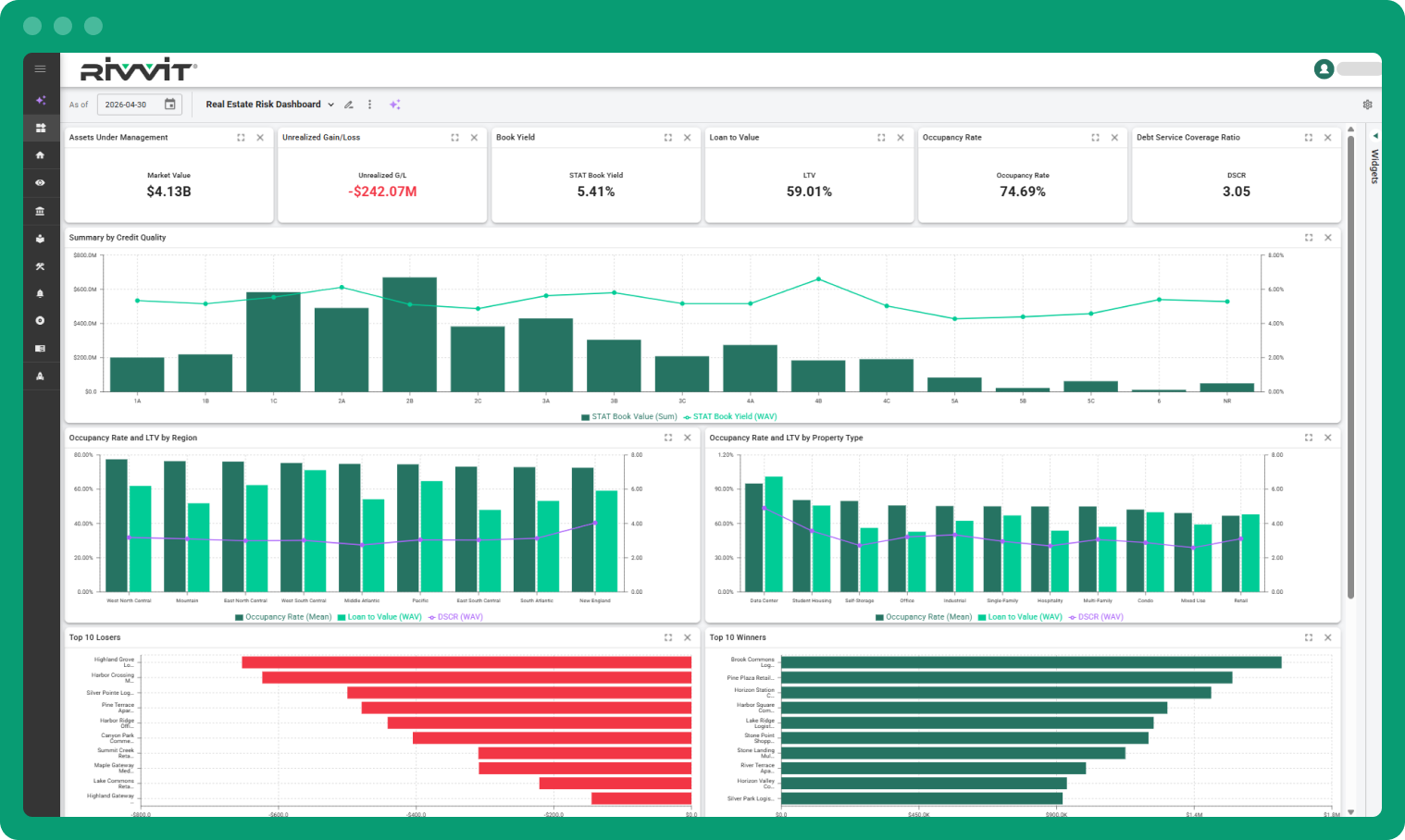
- Real-estate dashboard: Ask Rivvit’s AI agent something as simple as “build a real estate dashboard,” and you’ll get a complete dashboard that you can easily modify to fit your needs. In this example, you can see loan-to-values, occupancy rates, debt service coverage ratios, book yields, NAIC ratings, top winners and losers, and loan delinquencies for the mortgage book. Any of the data in this dashboard can be easily swapped out with a simple prompt to the AI agent.
- Manager Dashboard: Another example is a manager dashboard, where you can see key performance metrics across all your managers — for example, book yield, duration, weighted average life, credit quality, and RBC charges. Drilling into the visuals, you can immediately spot outliers. In this example, one manager shows the highest book yield with a relatively low RBC charge and low exposure, a clear signal to look more closely and potentially allocate more to that manager.

Document intelligence
Upload the documents that govern your clients, portfolios, securities, and trades. Query them the way you would ask a colleague. The virtual analyst reads across them and pulls out what you need. In one example, we asked about the termination provisions for a credit agreement and got a detailed breakdown of all triggering and termination events. You can also analyze multiple documents simultaneously, such as comparing fee structures or strategies across multiple manager IMAs.
The firms that win with AI get the data right
At the conference in Chicago, someone asked the best question of the day:
“What separates the firms that get lasting value from AI from the ones that buy it and end up back in Excel six months later?”
The answer is always the same: it comes back to the data.
AI tools don’t fail. The analytical layer is not the problem. What fails is the foundation underneath, and along with it, the trust. If people don’t trust the data, they won’t trust the tools, and they won’t use them.
Trust is built through governance, a scheduled review of key metrics, and ability to drive decision-making. Once teams are making decisions on clean, trusted data, going back to Excel is never a real conversation. The value is too obvious, and the cost of reverting is too high.
Data is the fuel. AI is the reward.
Request a demo to see Rivvit’s virtual analyst in action.